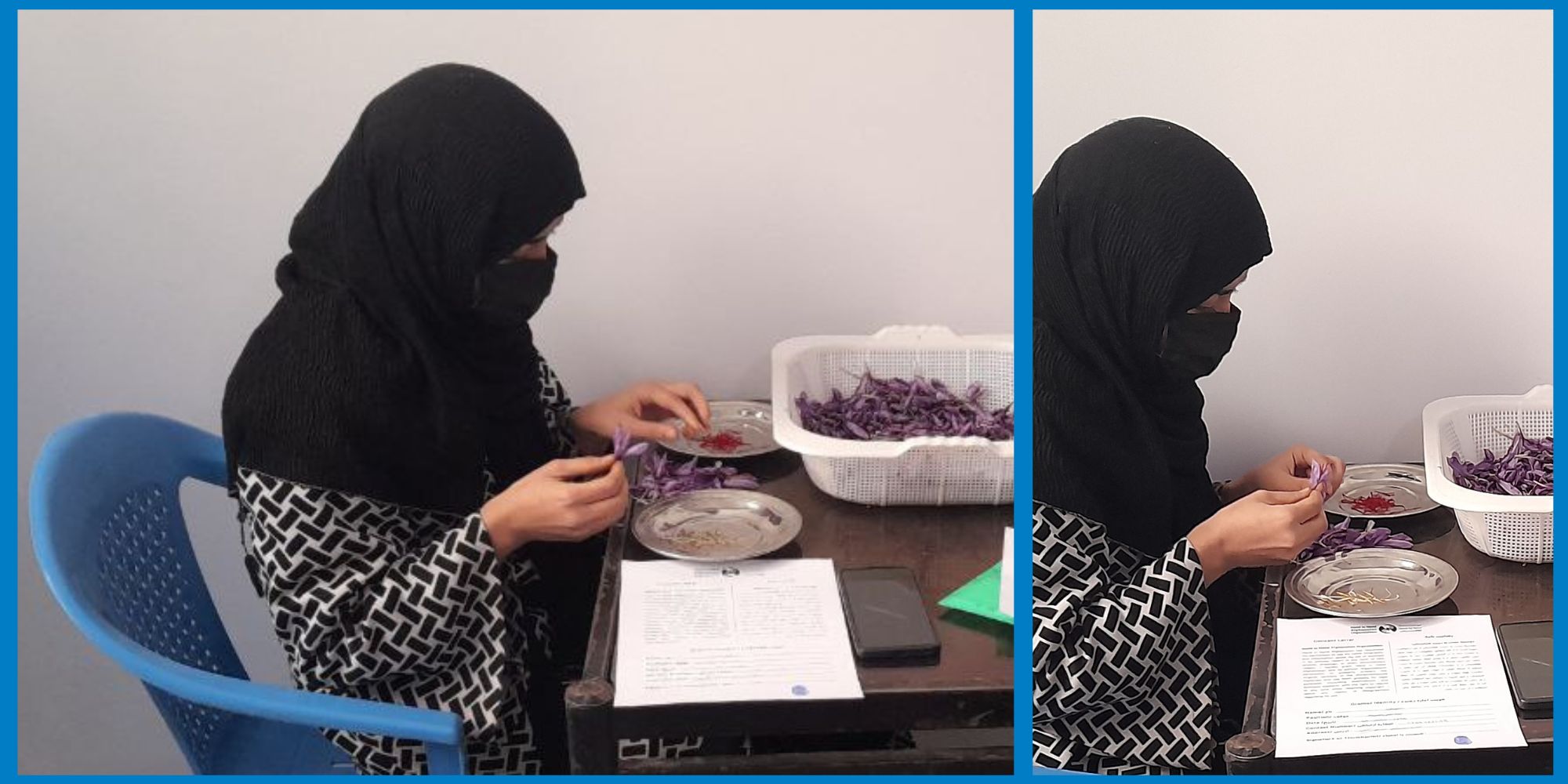
At just 24 years old, Sonita Faizi has become more than a saffron processor, she is now a trusted team leader among dozens of women working in a company supporting by Danida- Organic Growth – saffron project through Hand in Hand Afghanistan. processing center in Herat. Her story demonstrates how dignified employment, practical skills, and family support can empower women to contribute meaningfully to their households and communities.
Four years ago, Sonita joined Afghan Royal after being introduced by her cousin, who was already employed at the company. Having previously processed saffron from home for small traders, she brought valuable experience to the company. Today, in addition to processing saffron, she supervises other women workers.
“I started working because our family’s financial situation was weak. I wanted to earn an income so I could help cover our household expenses.”
Sonita lives with her husband, mother-in-law, and teenage nephew. Her husband earns a modest income transporting goods with a handcart near the Afghan Market, while her mother-in-law suffers from chronic back pain and cannot work. Together, Sonita and her husband shoulder the family’s financial responsibilities.
The company pays her 100 Afghanis for every kilogram of saffron processed and provides lunch to all employees, as food preparation is prohibited inside the processing center to protect the delicate aroma and quality of the saffron.
Before joining Afghan Royal, Sonita processed up to 50 kilograms of saffron at home for smaller companies. However, working in a professionally managed processing center has enabled her to improve both her income and technical knowledge.
Through training supported by Hand in Hand Afghanistan under the DANIDA-funded project, Sonita and other women participated in two specialized courses on organic saffron processing. During the training, participants also received daily allowances and meals.
“Before the training, I didn’t know there was a difference between organic and non-organic saffron. Now I understand why organic saffron requires much stricter hygiene standards and careful handling.”
The training introduced international quality standards, including proper handwashing techniques, contamination prevention, and the importance of keeping food odors away from saffron during processing. New equipment, including drying machines, tables, chairs, and baskets, was also provided to improve working conditions and product quality.
According to Sonita, these investments have significantly improved the quality of their work.
“The information we learned was completely new and very useful. Since the training, I have become much more careful in my work, and my processing has improved.”
Although this year’s saffron harvest has been smaller than previous years, Sonita has witnessed remarkable growth in women’s participation over recent seasons.
“More women have joined the company every year because the payment for processing organic saffron here is better than what smaller companies pay for home-based work.”
Like many Afghan women, Sonita has occasionally faced criticism from extended relatives who believe women should not work outside the home. However, the encouragement she receives from her immediate family has allowed her to continue confidently.
“Some relatives say it is not appropriate for a woman to work in a company, but my family supports me because they know everyone here is a woman, and they see that I help with the household expenses.”
Her earnings have brought tangible improvements to her family’s wellbeing. Last year alone, she earned around 2,500 Afghanis during the saffron season, which she used to purchase food, medicine, and warm winter clothing for herself and her mother-in-law.
“With the income I earn, I can buy food, medicine, and winter clothes for my family. Before, when I worked from home, my income was much lower and I couldn’t contribute much to our household.”
Beyond supporting her own family, Sonita has also become a source of opportunity for other women. By sharing the knowledge she gained and introducing women to employment opportunities, she estimates that nearly 30 women, including relatives, friends, and neighbors, have been able to earn an income either at Afghan Royal or through home-based saffron processing.
“I have shared what I learned about organic and non-organic saffron with my relatives and friends. Over the years, around 30 women have been able to find work because of my support.”
For Sonita, the greatest achievement is not only the income but also the confidence and independence that come with it.
“Receiving my wages and being financially independent is the most rewarding part of this work.”
Looking ahead, she hopes to continue working every saffron season while calling for more projects that create employment opportunities for Afghan women in areas such as tailoring, nut processing, and other small businesses.
Her message to other women is simple yet powerful:
“Women should work and contribute to their household expenses. When women earn an income, they can support their families and build a better future.”